Explore my direction
What gives me energy? What do I enjoy? What can I do, and what would I like to develop?
Explore what matters to you.
What do you enjoy doing? What can you do, and what would you like to develop? What do you care about? And what do you need to thrive in life, studies and work? This exercise lets you explore your interests, strengths, values, needs and possibilities. You do not need to know what you want to be or have a finished plan.
About 10–15 minutes · Four areas · No right or wrong answers
The time is approximate – take the time you need.
What gives me energy? What do I enjoy? What can I do, and what would I like to develop?
What drains my energy? Which settings do I want to avoid? Which conditions and needs matter to me?
Based on Reverse Ikigai – the same four areas seen from the other side: what you want less of and what you need.
You can do one exercise or both. You do not need to write long answers and you can skip questions. What matters most is giving your thoughts some space.
Your answers are saved only in this browser (local storage) as you type. Nothing is sent to a server and no AI is used. You can download a backup, load it again or delete everything here.
Ikigai is a Japanese concept that roughly means what makes life meaningful or worth living. It can involve work, but just as much relationships, hobbies, everyday tasks or being important to someone.
The diagram with four overlapping circles is a modern Western interpretation. It is not a full description of the Japanese concept and not a test that decides which career suits you. Here the four areas are used as open questions.
Nobody has to be in the middle. A job that mainly gives security and an income is a fully legitimate choice, and meaning can be found in family, friends, community or nature.
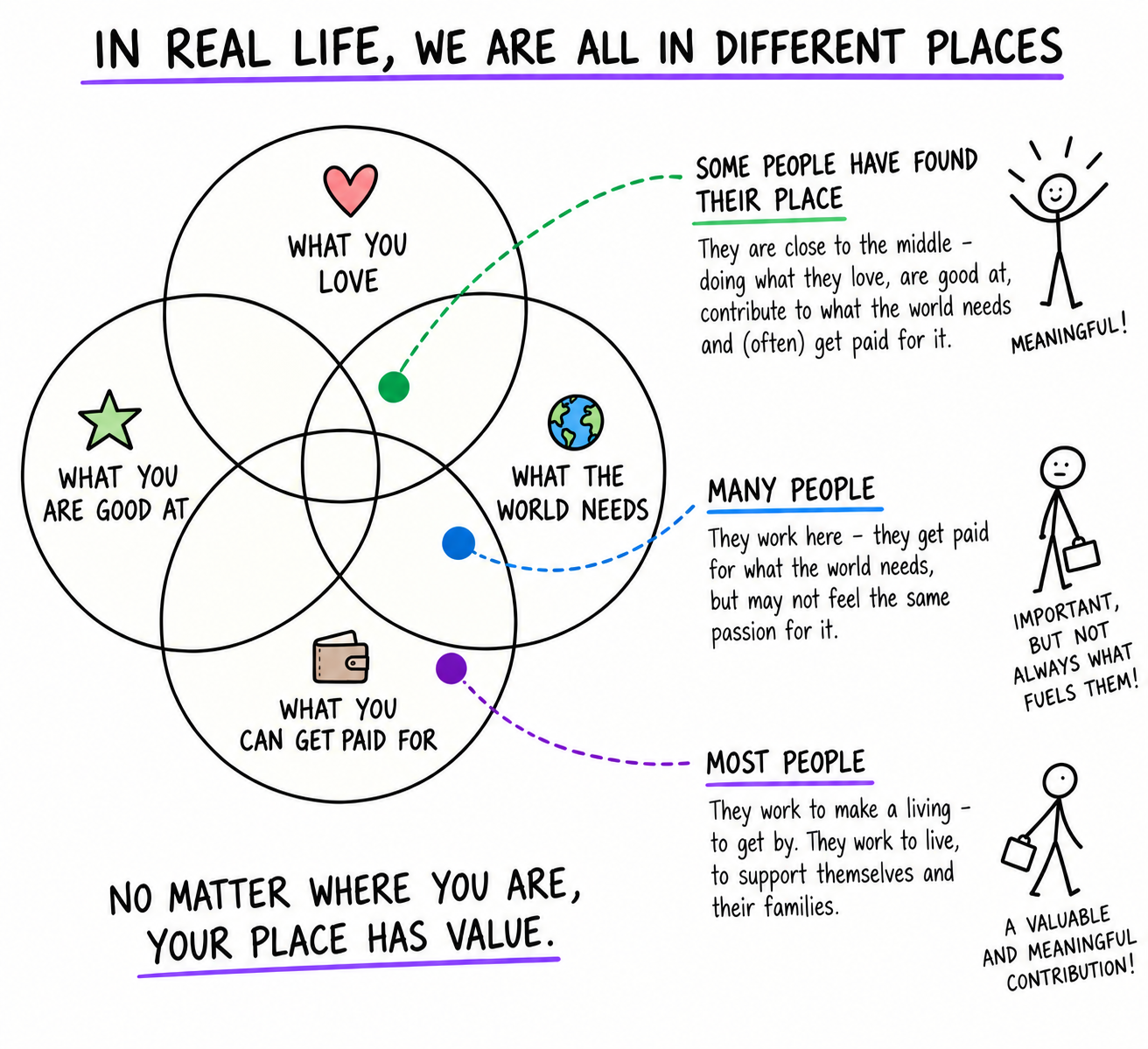
The illustration shows possible relationships between work and meaning. It is not a research finding.
Green Guidance means that questions about climate, environment, sustainability and social justice get space in conversations about education and work.
“The world” can mean your neighbourhood as much as the planet. Helping a neighbour, making a workplace safer or wasting less food are contributions too.
The exercise works in one-to-one conversations, in teaching and in workshops. Let participants work alone for a few minutes per area and then talk in pairs or groups. Nobody needs to show their answers.
This exercise is a reflection aid, not a test. It gives no scores and does not match you with a career. Reverse Ikigai is an independent educational adaptation for joakimcao.se, not a standardised method. Answers are stored only locally in your browser and can be deleted under “Manage my answers”.
Inspired by reflection activities in Green Guidance and further developed for joakimcao.se. The Green Guidance Toolbox is described as CC BY 4.0.